The short answer. InSightOS breaks a budget vs actual variance into drivers that add up to the total, links each driver to the transactions behind it, and drafts commentary that cites those transactions. The numbers are calculated from your ledger, so the same question gives the same answer every time, and an analyst checks the evidence instead of rebuilding it.
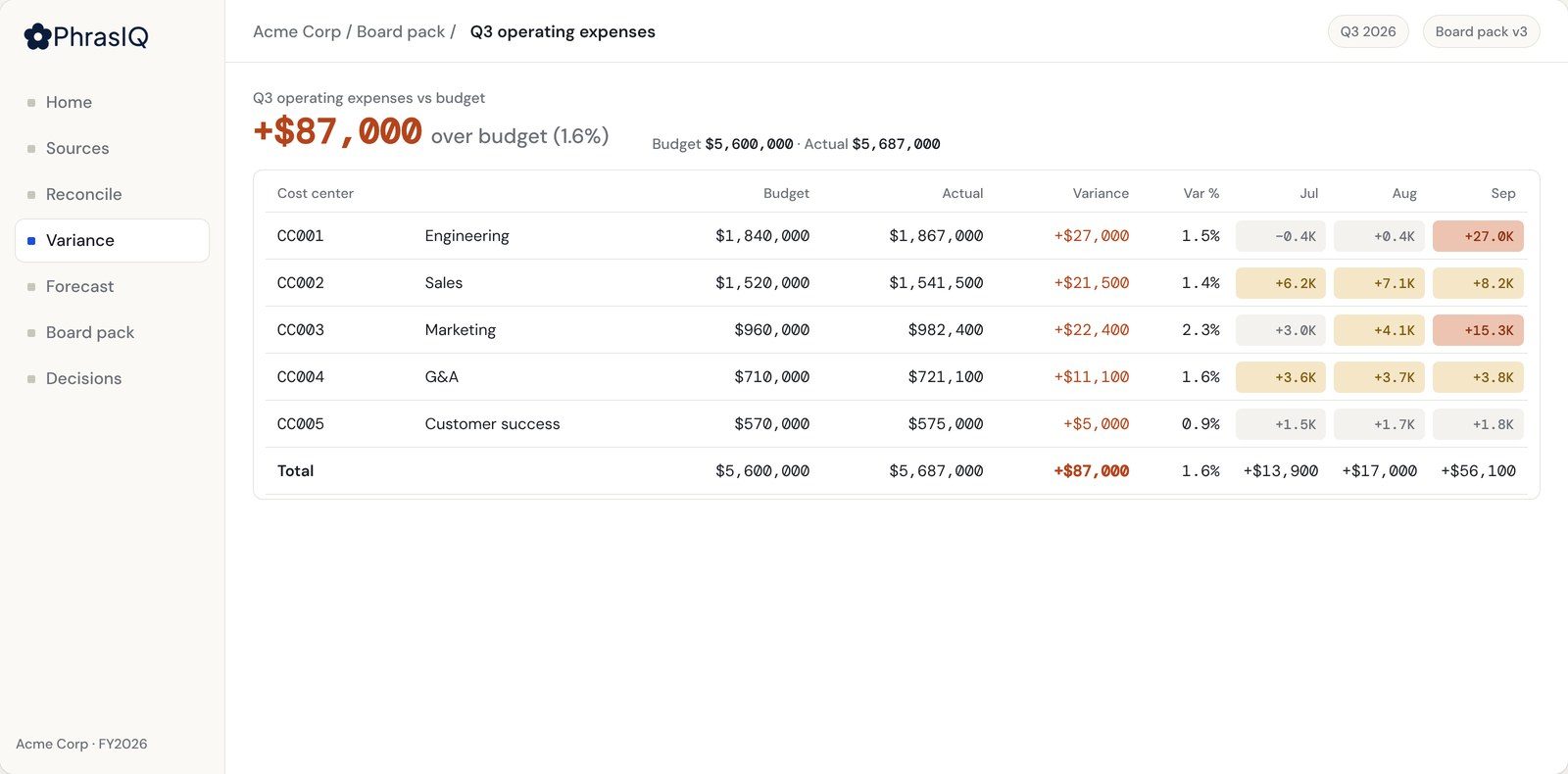
Every figure on this page comes from one worked Q3 close for a Series B SaaS company, the same example shown in our product walkthrough. Operating expenses: budget $5,600,000, actual $5,687,000.
Why does explaining a variance take days?
Finding the variance takes a minute. The table says operating expenses came in $87,000 (1.6%) over budget. Explaining it takes days, because the answer sits in five places: the ledger export, the AP system, the contract folder, the plan file and someone's inbox. Each step is manual, and each hand-off is a chance for the number to drift.
By the time the explanation is ready, the CFO has asked a second question, and the analyst starts again.
How does InSightOS explain a variance?
- Flags it. The close cockpit lists exceptions against a rule your team sets, for example variance over 1% and over $10,000. The $87,000 overrun is flagged with a drafted first answer.
- Breaks it down. The cost-center table shows budget, actual and variance, with monthly heat cells. Engineering (+$27,000) and Marketing (+$22,400) account for $49,400 of the $87,000, most of it in September.
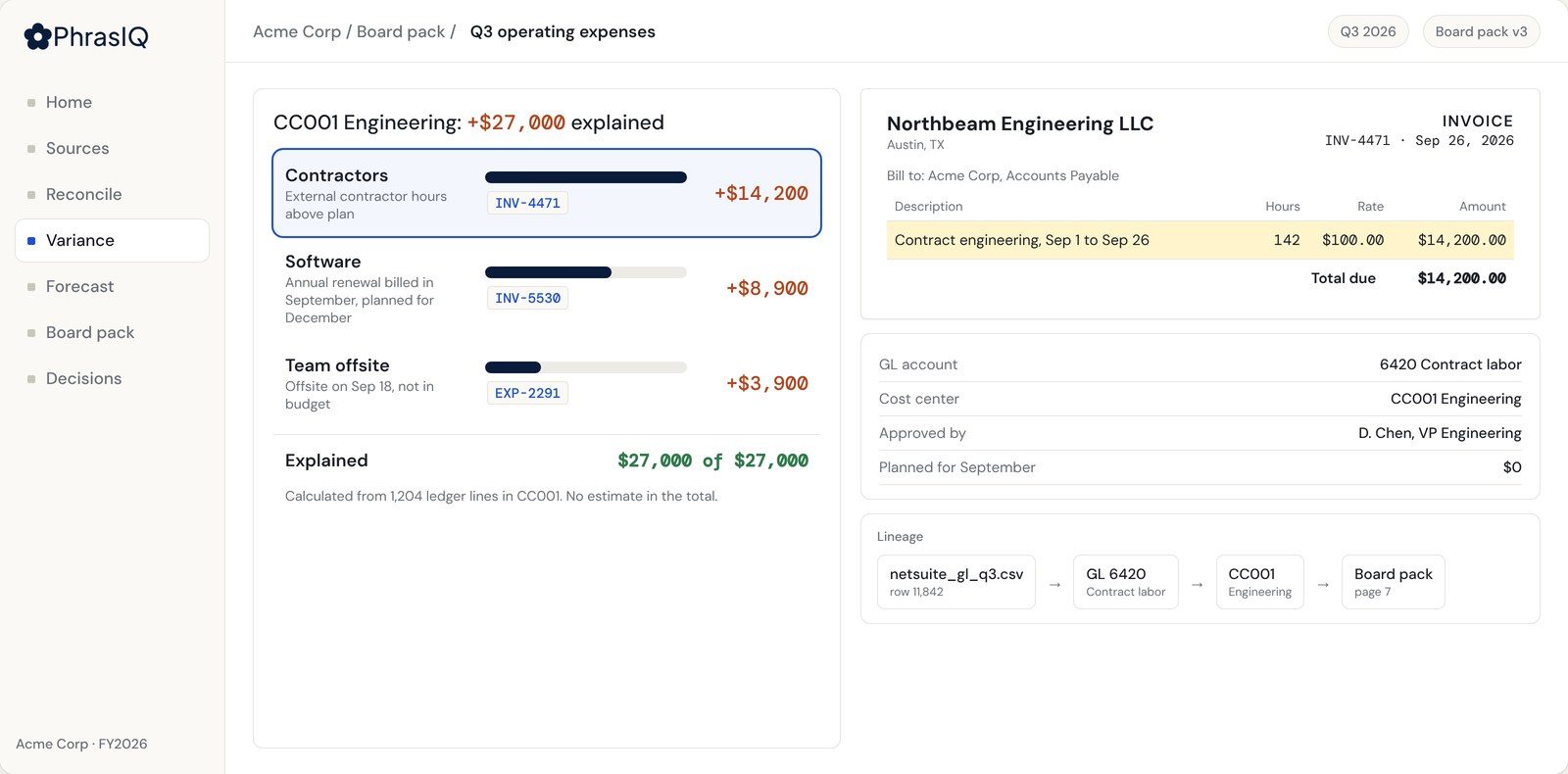
- Explains each line. Click Engineering and the $27,000 splits into three drivers: contractors +$14,200, a software renewal billed early +$8,900, and a team offsite +$3,900. They add up to $27,000 of $27,000.
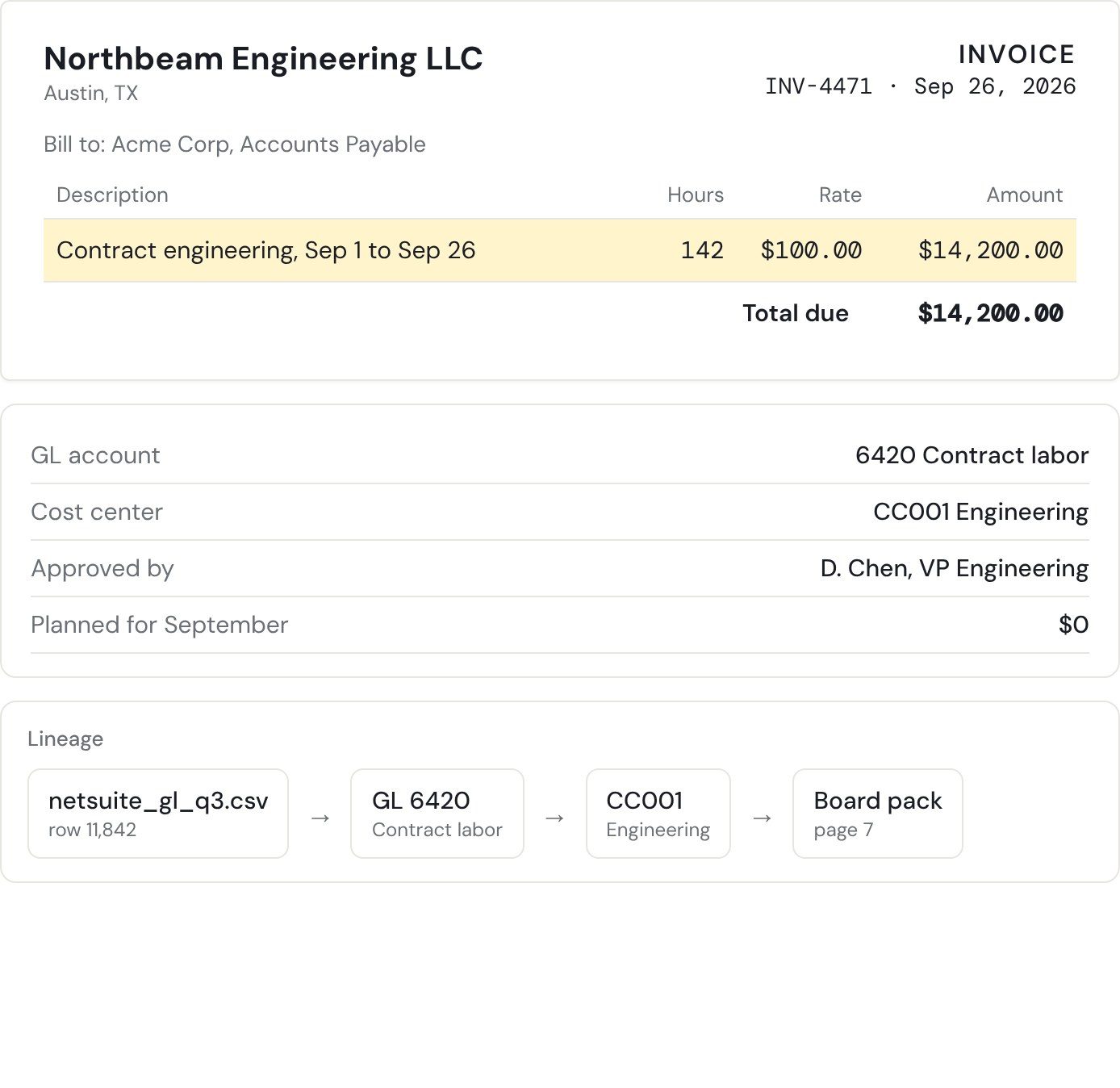
- Opens the source. Click the contractor line and the vendor bill opens: 142 hours at $100, $14,200, approved by the VP Engineering, with its lineage from the export row to page 7 of the board pack.
What does a finished explanation look like?
| Driver | Amount | Source | Type |
|---|---|---|---|
| Contractor hours above plan | +$14,200 | INV-4471 | Run-rate, added to the Q4 forecast |
| Annual software renewal billed in September, planned for December | +$8,900 | INV-5530, contract CT-118 | Timing, reverses in Q4 |
| Team offsite, not in budget | +$3,900 | EXP-2291 | One-time |
| CC001 Engineering | +$27,000 | 1,204 ledger lines | Explained in full |
Each row is something a reviewer can check in one click. That is the standard to hold any variance tool to: the drivers sum to the total, and every driver has a document behind it.
Which numbers are calculated and which are written?
The variance, the drivers and the totals are calculated from the ledger, the plan and the source documents. The commentary is drafted by InSightOS and edited by your team, and the board pack marks which is which. A reviewer can always tell a number that came from the ledger from a sentence that came from a model.
What should you check before trusting a variance tool?
- Do the drivers add up to the variance, to the dollar?
- Can you open the source document for each driver?
- Does the same question on the same data give the same answer tomorrow?
- Is the explanation logged, with who edited and approved it?
Our field guide to budget vs actual variance walks through the method step by step, with or without software.
Frequently asked questions
What is variance analysis software?
Software that compares actuals with budget or forecast, breaks the difference into drivers such as price, volume, timing and one-time items, and links each driver to the transactions behind it. The useful ones also draft the explanation and record who approved it.
How is this different from a BI dashboard?
A dashboard shows that a number moved. InSightOS explains why, with drivers that add up to the total and a source document behind each one, and keeps the explanation for the next close.
Do the drivers always add up to the variance?
Yes. If part of a variance cannot be traced, InSightOS shows the unexplained amount instead of hiding it, so you can see exactly what is left to investigate.
Which systems does it work with?
InSightOS works from exports of your ERP, CRM, billing, payroll and warehouse today. Direct connectors are planned.
Who approves the commentary?
Your team. InSightOS drafts it with citations; an analyst edits it and the CFO approves it, and every step is in the audit trail.