The short answer. InSightOS loads your ledger, billing, CRM and payroll exports into one finance model, runs close checks across them, and lists every exception on one screen with an owner, a status and a drafted explanation. Problems like a revenue cutoff error or a duplicate vendor show up on day 4 of the close instead of in the board meeting.
The figures on this page come from one worked Q3 close for a Series B SaaS company, the same example shown in our product walkthrough: day 4 of a 6-day close, 41 of 48 tasks done.
Why do close problems surface so late?
Most close checklists confirm that a task was done, not that the numbers agree. The ledger can be tied out while billing and the CRM disagree with it, and nobody notices until someone builds the board deck and the revenue line does not match the sales number.
What does InSightOS check during the close?
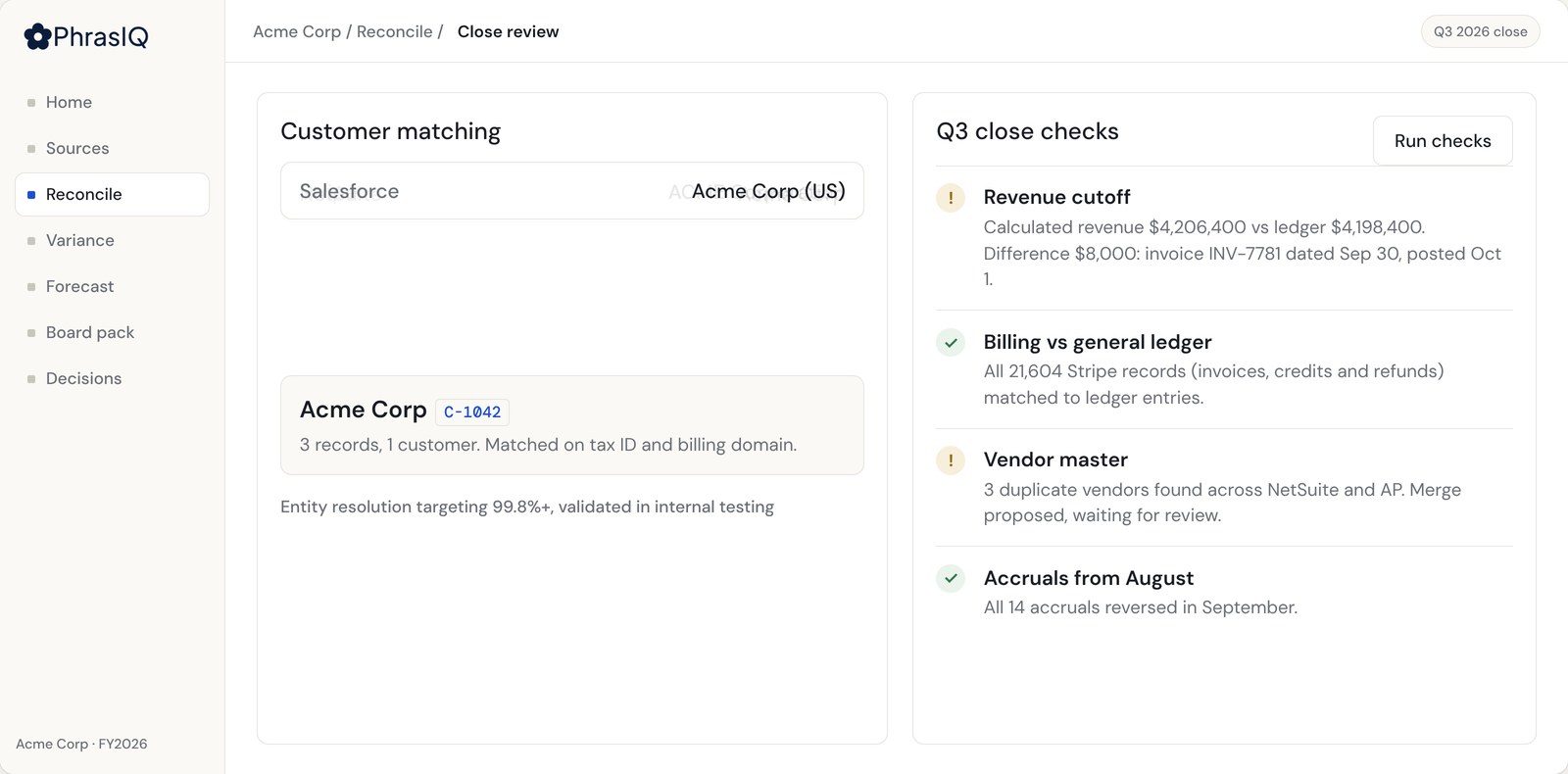
| Check | What it found in the Q3 close | Status |
|---|---|---|
| Revenue cutoff | Calculated revenue $4,206,400 vs ledger $4,198,400. Difference $8,000: invoice INV-7781 dated Sep 30, posted Oct 1. | Accrual proposed |
| Billing vs general ledger | All 21,604 Stripe records (invoices, credits and refunds) matched to ledger entries. | Passed |
| Vendor master | 3 duplicate vendors across NetSuite and AP. Merge proposed. | In review |
| Accrual reversals | All 14 August accruals reversed in September. | Passed |
| Customer matching | 3 records for Acme Corp across Salesforce, Stripe and NetSuite matched to one customer on tax ID and billing domain. | Matched |
What is on the close cockpit?
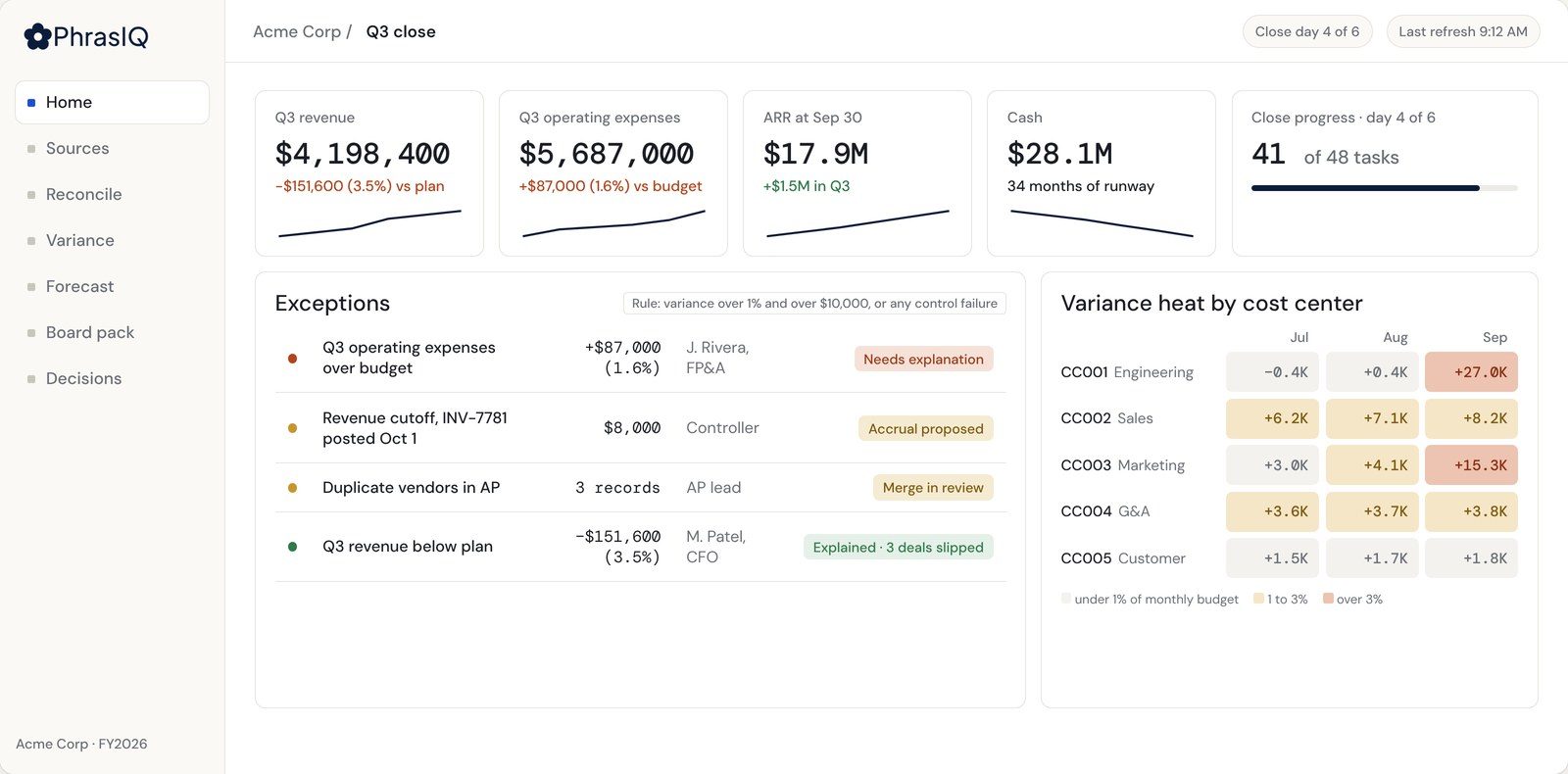
One screen with the numbers that matter for the quarter and everything still open:
- Q3 revenue $4,198,400, $151,600 (3.5%) below plan; operating expenses $5,687,000, $87,000 (1.6%) over budget; ARR $17.9M; cash $28.1M.
- Close progress: day 4 of 6, 41 of 48 tasks.
- Exceptions against a rule you set (variance over 1% and over $10,000, or any control failure), each with an owner and a status.
- A heat map of cost-center variances by month, so a September spike stands out before anyone asks.
How do exceptions get resolved?
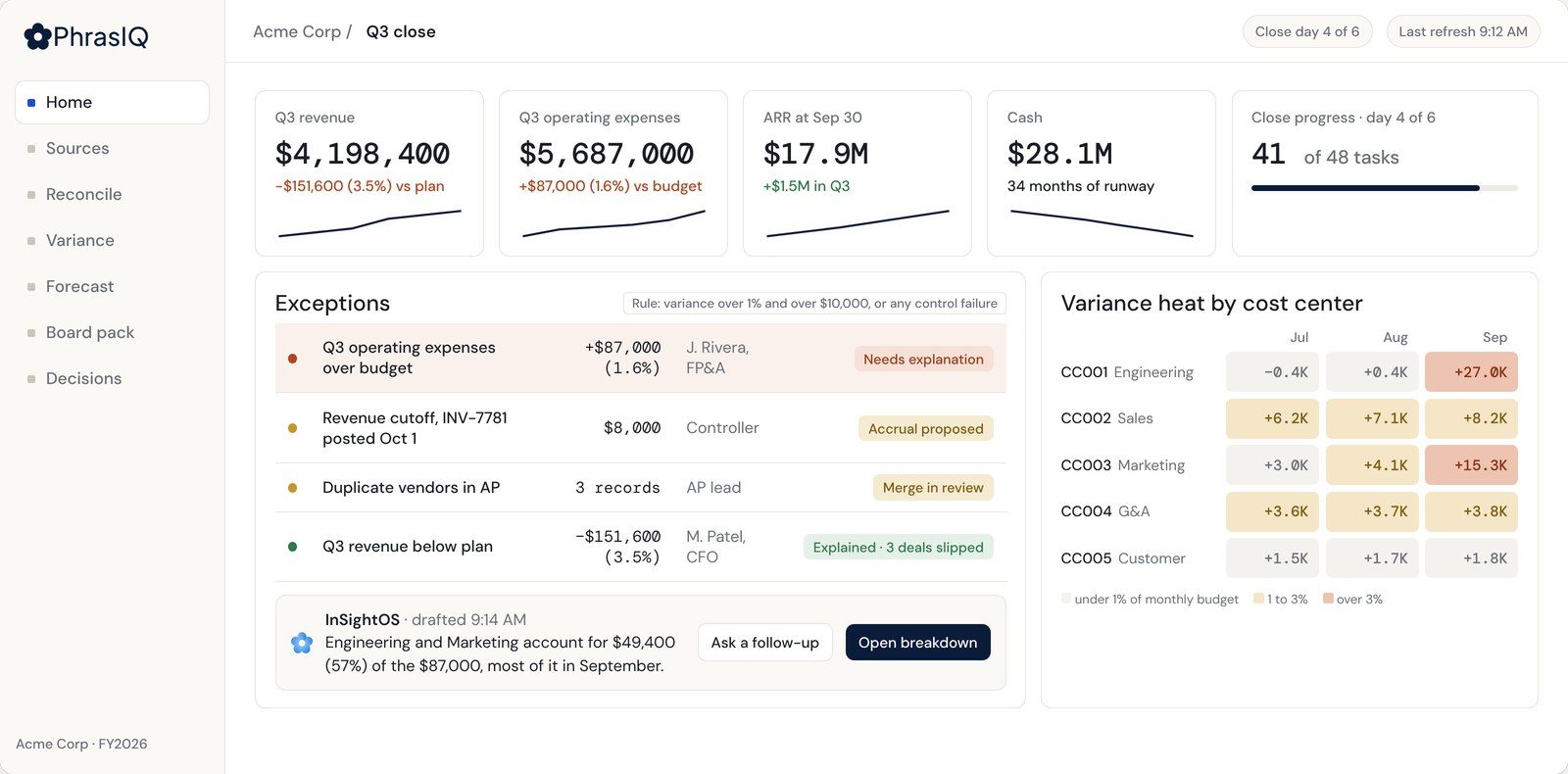
Each exception arrives with a drafted answer. For the opex overrun, InSightOS wrote: "Engineering and Marketing account for $49,400 (57%) of the $87,000, most of it in September." The owner can open the breakdown, ask a follow-up, or assign a task with a due date. Every decision is stored, so next quarter starts from this one.
How does the data get in?
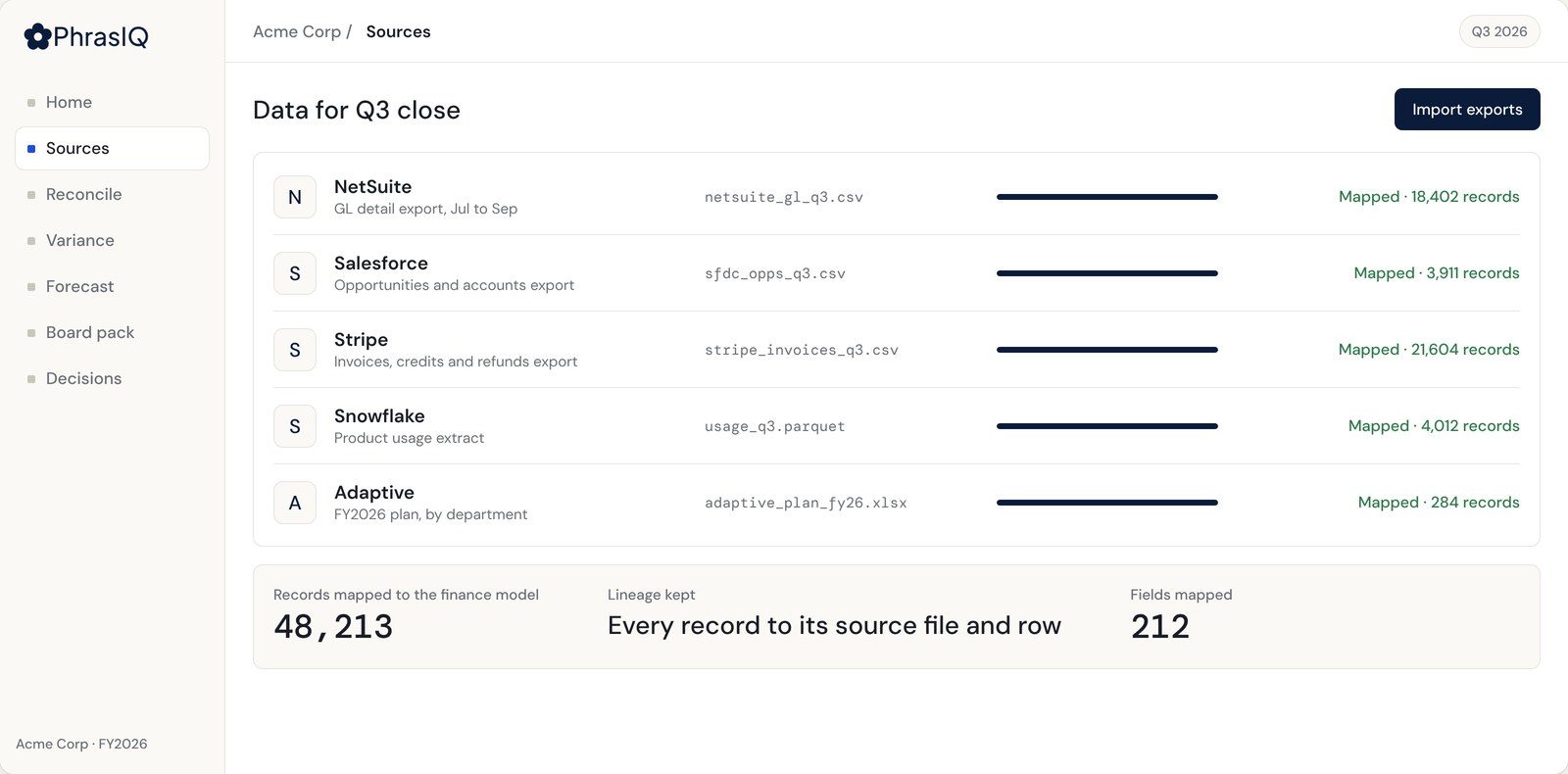
Exports from each system: the GL detail, opportunities, invoices and credits, usage and the plan. Loktak maps every field to one finance schema, your team approves the mapping once, and every record keeps a link to the file and row it came from. Entity resolution, the matching of the same customer or vendor across systems, is targeting 99.8%+, validated in internal testing. Direct connectors are planned.
Frequently asked questions
Does InSightOS replace our close checklist?
It complements it. Your checklist confirms tasks are done; InSightOS checks that the numbers agree across systems and shows what is still open.
What counts as an exception?
Whatever your rule says. A common rule is any variance over 1% and over $10,000, plus any failed control such as a cutoff error or a duplicate vendor.
Can our auditors see what was done?
Yes. Every check, mapping approval, edit and sign-off is recorded with who, when and why, and the log can be exported.
How long does setup take?
Setup starts from exports you already produce. The field mapping is proposed by Loktak and approved by your team once; after that each close reuses it.
Is our data used to train models?
No. PhrasIQ does not use customer data to train shared foundation models. SOC 2 and ISO 27001 audits are in progress.