The short answer. Bookings, billings and revenue are different numbers for good reasons. InSightOS builds the bridge between them from your CRM, billing and ledger exports, explains each step with its source records, and flags the differences that are errors rather than timing, such as an invoice posted in the wrong period.
Five systems, five Q3 numbers, from the same Series B SaaS company as our product walkthrough.
Why does every system show a different revenue number?
| System | Q3 number | Why it differs |
|---|---|---|
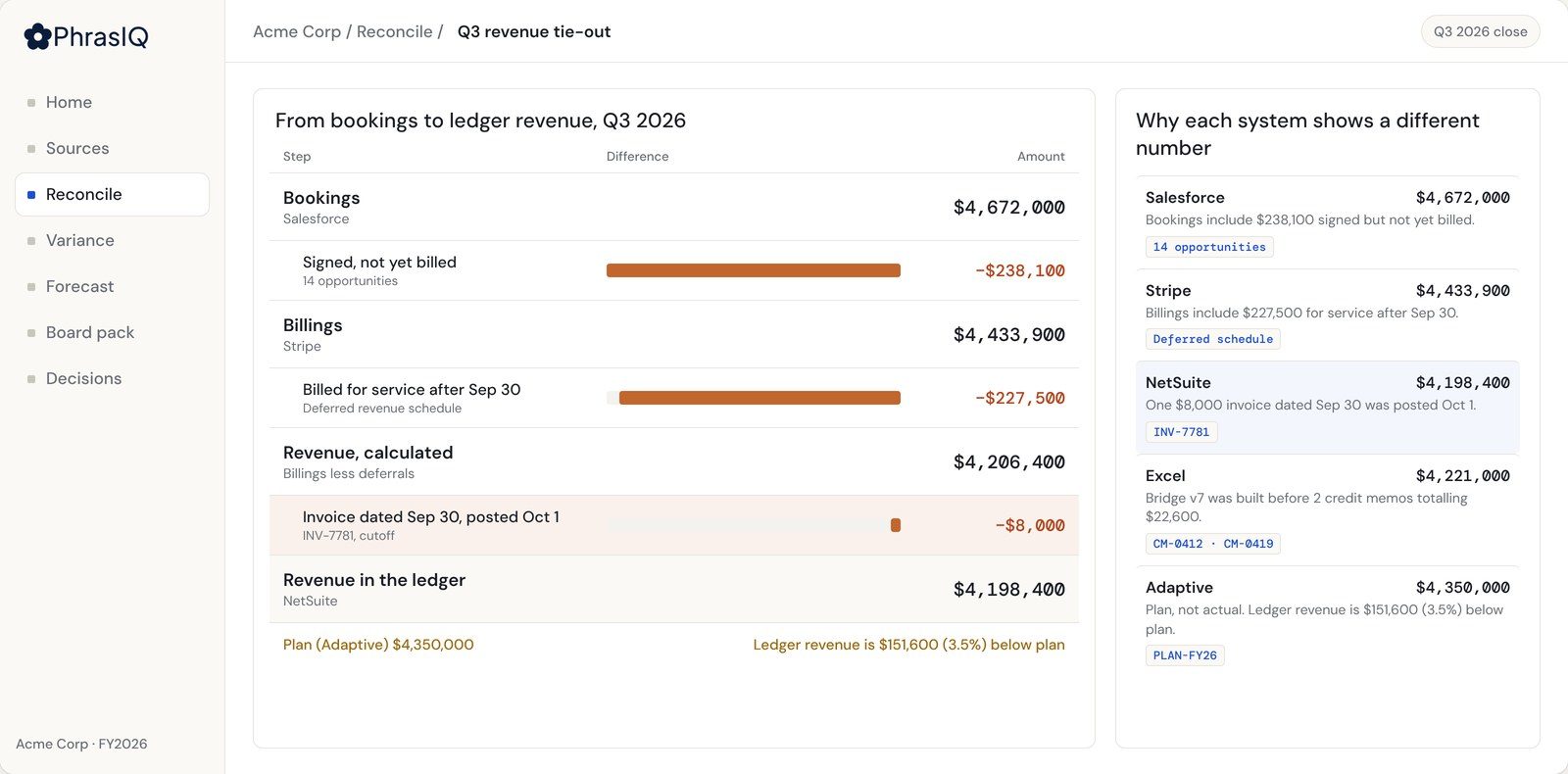
| Salesforce | $4,672,000 | Bookings: includes $238,100 signed but not yet billed (14 opportunities). |
| Stripe | $4,433,900 | Billings: includes $227,500 for service after Sep 30, which is deferred. |
| NetSuite | $4,198,400 | Revenue in the ledger: one $8,000 invoice dated Sep 30 was posted Oct 1. |
| Excel | $4,221,000 | Bridge v7 was built before 2 credit memos totalling $22,600. |
| Adaptive | $4,350,000 | The plan, not an actual. Ledger revenue is $151,600 (3.5%) below it. |
How do bookings become ledger revenue?
Step by step, each with its source:
| Step | Amount |
|---|---|
| Bookings (Salesforce) | $4,672,000 |
| Signed, not yet billed | −$238,100 |
| Billings (Stripe) | $4,433,900 |
| Billed for service after Sep 30 (deferred) | −$227,500 |
| Revenue, calculated from billings | $4,206,400 |
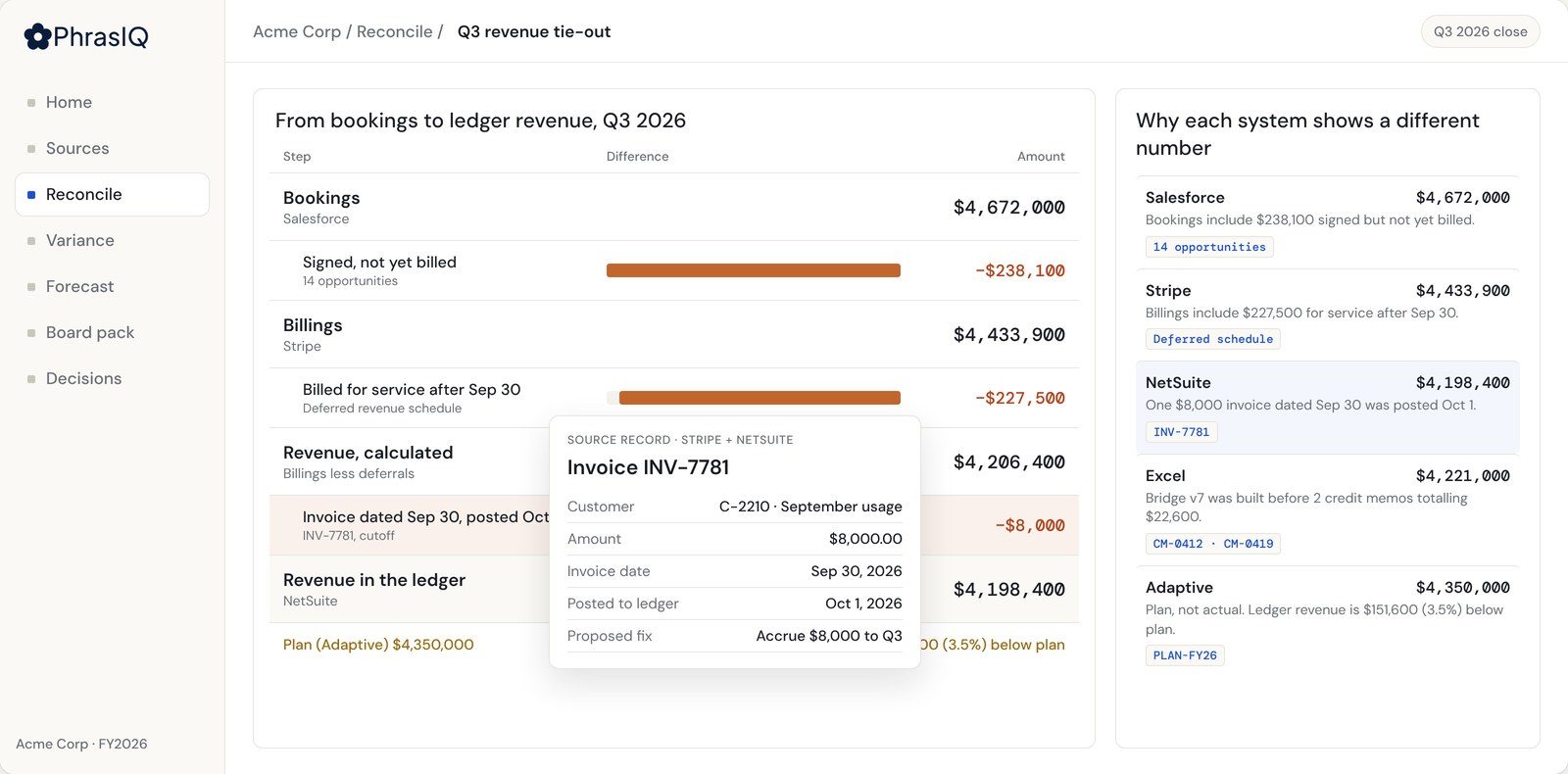
| Invoice dated Sep 30, posted Oct 1 (INV-7781) | −$8,000 |
| Revenue in the ledger (NetSuite) | $4,198,400 |
Two of those steps are how SaaS revenue works. The third is a mistake: an invoice for September usage, dated Sep 30, posted to the ledger on Oct 1. The proposed fix is to accrue $8,000 to Q3, and it is listed as an exception on the close cockpit until someone accepts or rejects it.
How does InSightOS match customers across systems?
The same customer appears as "Acme Corp (US)" in Salesforce, "ACME Corporation" in Stripe and "Acme Corp" in NetSuite. Loktak matches them to one customer on tax ID and billing domain and keeps the match, with its evidence, for review. Entity resolution is targeting 99.8%+, validated in internal testing. Without that match, no bridge between systems can be trusted.
What should a revenue tie-out include?
- Every system's number, with the reason it differs, not just the ledger figure.
- Steps that add up exactly, from bookings to ledger revenue.
- A source record behind each step.
- A clear split between timing differences and errors, with the errors assigned to an owner.
Frequently asked questions
Why are bookings, billings and revenue different?
Bookings are signed contracts, billings are invoices sent, and revenue is what has been earned under your revenue recognition policy. Timing between the three is normal; the tie-out shows how much is timing and how much is error.
Which number goes in the board pack?
Ledger revenue, after any approved corrections. The tie-out explains how it relates to the bookings and billings numbers that sales and finance also quote.
What is a revenue cutoff error?
Revenue recorded in the wrong period, for example a September invoice posted in October. The tie-out catches it because calculated revenue and ledger revenue disagree by the invoice amount.
Which systems are supported?
InSightOS works from exports of your CRM, billing system, ledger and spreadsheets today. Direct connectors are planned.
How often should we run it?
Every close, before the numbers are locked. Once the mappings are approved, it reruns on the new exports.